Biography
Biography
Japanese painter, settled in Ripoll
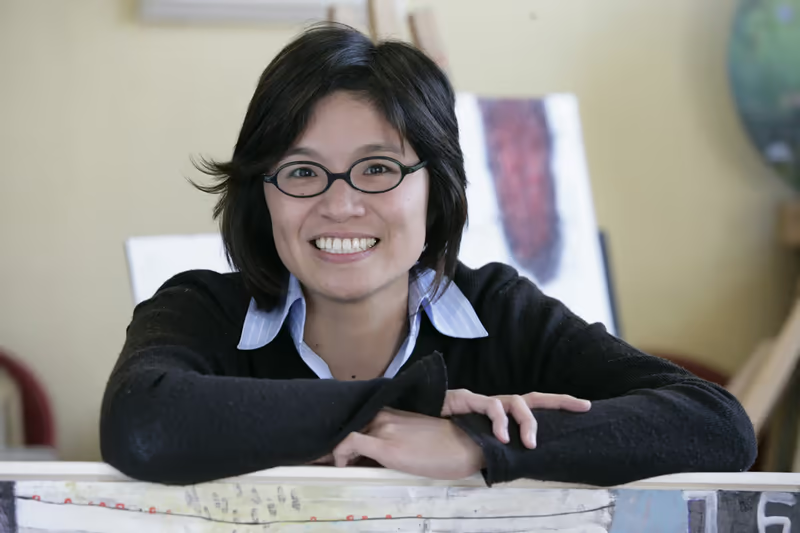
Chikako Taketani was born in Kyoto in 1962. She earned her Fine Arts degree from Saga Bijutsu Daigaku, where she trained in traditional Japanese painting — a discipline she mastered but felt was too rigid for what she wanted to say.
Before settling in Catalonia she travelled through Senegal, Mali, Vietnam, France and Portugal: an itinerary that gradually drew her away from Japan and opened her eyes to other lights, other colours. Around 2002 she arrived at the Fundació Rodríguez-Amat in the Baix Empordà — an artist residency she came to with doubts about the direction her painting should take.
There she met Domènec Batalla, a Ripoll-born sculptor and painter. During a working session, he picked up a sponge soaked in red paint and threw it at her canvas with a playful «look». That simple gesture freed her from the formal rigour she had carried with her and opened the most fertile period of her painting. In 2003 she moved with him to Ripoll, where they would share a studio in a converted two-storey industrial building.
Her painting — intimate and introspective — gathers around a few recurring motifs: girls in kimono with elongated limbs and impossible postures, trains and windows, cats, faintly evoked buildings. She works with glues, pigments and adhesives that produce transparencies and glazes — pearly, warm atmospheres broken by sudden bursts of colour. Her palette, closer to the Mediterranean than to Japan, speaks the language of the place she had chosen to live in.
Over the years, the faces of her figures gradually fade: first the mouth, then the nose, finally even the eyes. A conscious pursuit of depth and silence. Selected for the Girona Art Biennial (2006, 2008) and a finalist for the Honda Painting Prize of La Garriga (2006). In 2009 she held her first solo exhibition in the Osona region at the Temple Romà in Vic, and presented joint shows with Domènec — among them one at the Casal Sant Martí de Campelles (seven of his sculptures, fourteen of her paintings).
In 2011, together with Domènec, she travelled to Costa Rica at the invitation of the architect Joan Puigcorbé: for two months she painted «Canción de viento», a large mural integrated into Casa Altamira in Ciudad Colón — the atmosphere, the wind, the leaves, the changes of the place transformed into paint. In her final years she crossed Japan often by train to be with her ailing father: two hours a day of rails, windows and suspended time which seeped into her late work and pushed it toward a freer abstraction. She died on 2 August 2013.